


- Your cart is currently empty.
How to Create a Top Blog Post Twice as Fast


Time is a precious commodity that is scarce for everyone. Some more, others less.
If your job involves writing blog posts, you probably know that time literally flies when you’re writing. I’m sure you’ve thought how nice it would be to be able to write an article faster, without compromising on quality.
Even watching world-renowned writers online can sometimes be a bit demotivating, as they produce large amounts of high-quality content on a daily basis. You just wonder: “How the hell do they do it?”
It is undoubtedly true that they have a lot of mileage under their belt. But it’s not just experience that leads an individual to write faster and better. Just a few “tricks”can help you to improve your results tremendously.
Imagine if you could write your articles in even less time than you currently do. That would mean more articles written or more time that could be usefully spent on other activities.
A few more quality articles a month can greatly accelerate the growth of a business.
Read on to find out how you can improve your writing skills and increase your efficiency in a relatively easy way.
1. Learn to type fast
Are you always full of ideas and know exactly what to write? Great, you definitely have a gift that will come in handy when it comes to writing. But even if you’re extremely creative, you can’t finish a piece quickly if you’re not very good at typing.
So learn to type fast as soon as possible! You’ll write your article much faster if you learn what’s called blind typing. It is also important to use all ten fingers.
To get started, take a look at the picture below, which shows the correct position of the hands on the keyboard.
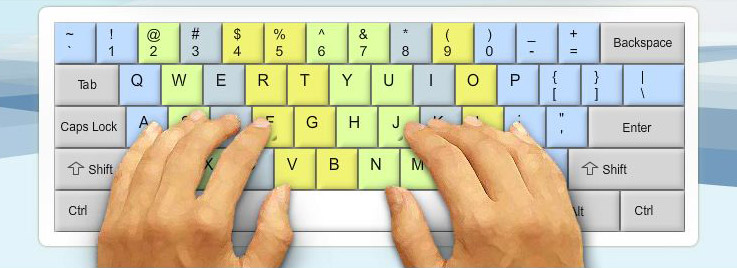
You can learn how to type with ten fingers by visiting the Touch Typing Study website. Find “English” among the many buttons and click on it.
I recommend that you first read the hints provided by the app.
Place your left index finger on the “F” key, your right index finger on the “J” key and both thumbs on the “space” key. Once you are familiar with the hints, start practicing.
Think typing 50 words per minute is a lot? For someone who is used to typing blind, it’s no big deal. But if you’re not comfortable with typing, it’s definitely enough to get you started. After all, you could write as many as 3,000 words in an hour this way.
Curious how fast you type? Check out the following two links:
On both sites you can test yourself to see how fast you can type and how many mistakes you make in the meantime. As you will see, some people achieve “crazy” results of 150+ words per minute.
Practice makes perfect. Keep practicing until you reach at least 50 words per minute.
2. Write down ideas and make a list
Ideas most often come spontaneously. When someone asks you to “Think of a title for an article quickly”, it’s not unusual if you can’t think of anything clever at that moment.
One of the good things about mobile phones and other portable devices is that we can always write things down. So if you have an idea, write it down immediately. Don’t rely too much on your memory, because in our fast-paced lives, information tends to slip our minds.
If you often have problems with what to prepare for your next blog post, I strongly recommend the following. Make a list of ideas.
Once a week (or once a month if you don’t post often), take an hour to think about it and write down at least 10 ideas or tentative titles for blog posts. Not all of them will be the best, but if half of them are interesting, you’re on your way.
It’s definitely better to have titles prepared in advance than to start thinking about what you could write about today every time you need to prepare a new post. This will save you more time than you might think.
You will also find many ideas on competitors’ blogs, thematic web portals, PDF manuals, e-books, etc.
3. Eliminate distractions
Do you often find that when you start something, you soon find yourself hanging out on Facebook?
Writing a quality post is anything but easy, so I’m sure sometimes you’d rather be checking keyword positions, checking stats in Google Analytics or simply going for a coffee with friends.
Sooner or later, you’re going to have to write an article, so get everything else out of your head as soon as possible and get to work. It is very important to stay focused and not be distracted while you are writing.
Log out of social networks, close Skype, Slack, WhatsApp and similar chat apps. It certainly won’t hurt to hide the bookmarks bar in your web browser.
If you work from home, turn off the TV and tell your partner and children not to disturb you. It’s much better to go to your office or library, a place where you can have some peace and quiet.

What about music? Is listening to music while preparing content recommended or not?
Several studies have shown that music can also be a distraction. Especially if the music is loud and has lyrics. In this case, you may quickly start singing in your head… If you must listen to music, it should be classical or ambient. Keep the volume to a minimum.
The following is also very important. Before you start writing, do all the necessary daily tasks. That way you won’t be thinking about chores and problems that might distract you while you are writing.
4. Research the topic thoroughly
If you write about something you are not familiar with and do not research the topic, you can expect to spend a lot of time on the writing itself, low quality of the publication and a bad mood and headache.
So do your research before you start writing. It is very important to do this at the very beginning, not during the writing process, as this will keep you focused on one activity. First on the research, then on the writing.
Keep the jumping between gathering data and writing to a minimum, as each mental leap takes some time, and even more time to get back into one of the activities. Not only does such jumping around steal time, it also takes more energy.
Copy interesting online resources into your word processor, save statistics and note down the findings of different studies.
Once you are familiar with the topic and have all the relevant information in one place, start writing. Not before.
5. Structure your post and write down the main points
Do you approach the writing of a new blog post by starting writing straight away after doing your research? It will be much better to roughly structure the post first.
I recommend that you write down all the subheadings first, and add a few bullet points for each one. These can also serve as small “H3” subheadings.

Don’t go into details, as the most important thing at this step is to have the main cues written down. This way, you won’t have to think over and over again what you wanted to say at each point while you are writing, and you won’t forget to include anything important in the paper.
When structuring your post, don’t forget to include an introduction and a conclusion. These are essential elements of any paper because:
- a good introduction engages the reader to continue reading,
- many readers read the conclusion first, and if it is not interesting, they leave the blog.
6. Write the article in full first, then edit it
Once you have the post roughly structured and the main points ready, it’s time to start writing. There are two ways to do this.
1. The first way is to edit sentences or paragraphs as you go along. So, you write a paragraph, read it and then improve or edit it. Then you write the next paragraph, edit it, and continue working in this way until the paper is finished.
2. Alternatively, you write the article first, and only when it is fully written do you start tweaking the sentences, making any additions, and filing down other bits and pieces.
You will have a blog post ready much faster if you choose the second way.
If you edit the post on the fly, your mind will be focused on writing first and improving second. When writing, you’ll be thinking, “What should I write?“, and when editing, “How can I improve it?“.
There will be mental leaps from one activity to another, which will reduce the efficiency of the work, and the paper will be completed more slowly.
7. Taking breaks while writing – yes or no?
Although it may seem that writing quality blog posts is a piece of cake, those of us who are in the business know all too well that this is not entirely the case.
So it’s only right that you take a break now and then to clear your mind.
Of course, a pause is not necessary in every case. If it’s a short article and the subject is simple or familiar, you can easily write it in one “breeze”.
How often you need to pause for longer articles depends on the individual, his/her ability to concentrate and his/her working habits. But it is definitely a good idea to take a break.

I recommend taking a 10 minute break every 45 minutes. You can use a timer on your mobile phone or an online app. When you return to writing after a break, it will take about 5 minutes to get back into the swing of things. This way, you can count 45 minutes of writing every hour.
Did your phone ring while you were preparing your content? Try to get through as quickly as possible, or better still, tell the person on the other end of the line that you’ll call them back when you’re done. This will also avoid the possibility that they will put some work on your plate or fill your mind with commitments, worries or whatever.
If the situation allows, stretch a little, drink a glass of water or have a small meal during your breaks.
8. Set a deadline by which the article will be written
Although nobody likes deadlines, they are very useful as they increase the efficiency of the work. Of course, they must be met (as much as possible).
Set the minimum time you think you can produce the article.
Why the shortest? If you take, for example, five hours to write an article, you will certainly not finish it sooner. Even if you could actually produce the article in three hours, you will have stretched the work and filled all the time you have taken to produce the article.
The deadline should apply to the writing of the article, but not to the editing. Although writing is the main part of the whole process, it is the editing that adds the most value to the article, so it is important to give yourself enough time to do it.
If you are not going to finish editing your paper in a reasonable time, set a deadline for that part too. Otherwise, you may find that you will improve and improve your sentences, but you may never be completely satisfied.
Setting deadlines works well in other areas too, for example if you want to check your website traffic statistics, analyse your advertising campaigns or just reply to emails. Set a time limit for these tasks too, and don’t exceed it.
You can’t imagine how much time you can save by doing this…
9. Write when you are most productive
Are you one of those people who have no problem getting up early, exercising every morning and eating breakfast with a full appetite? Or are you more of a night person, who could easily sleep an hour or so longer in the morning, but doesn’t think twice about going to bed early at night?
People are divided into morning and night birds, and some people don’t care whether they have to get up early or a bit later. Which group you fall into depends partly on your genes, but of course the body also gets used to the changed biorhythm relatively quickly.
Either way, the main thing is to know when you are most productive. If you are most productive in the morning, write in the morning. If you are better at creative work in the evening, write in the evening.

Not sure if you’re a morning or a night bird? Although it’s hard to believe, it won’t hurt to take a simple questionnaire on BuzzFeed.com. There you will quickly find out which group you belong to.
I would also like to mention an interesting study carried out by Mareike Wieth and Rose Zacks in 2011. They found that analytical tasks are better completed by the majority in their “optimal” time, while in-depth problems that require creative thinking are more easily solved in “sub-optimal” hours by a larger proportion of the study participants.
So check whether you do better in the morning, afternoon or evening. Even though you may be a nightbird, it may turn out that you write faster in the morning.
Follow these tips and write, write, write …
The well-known adage that practice makes perfect is very true. It’s no different when it comes to writing blog posts. So the main recipe for success is to stay motivated and write regularly.
Let’s say you currently manage to write 400 words in an hour. By the time you get to 500 words per hour, that’s already a 25% improvement. If you follow at least a few of today’s tips, I’m sure you can achieve that kind of improvement by the time you write your next article.
Let’s also assume that you write 5 days a week for 2 hours a day. That means that “old” you write 4,000 words in a week, and “new” you will write 5,000. And if you write articles of about 1,000 words, you will now be able to write one more per week.
And that’s just the start of rapid progress…
Perhaps you know a useful trick that helps you write articles faster and better? Comment and share your experience with other readers.
If you’ve tried speed typing at one of the links mentioned in the first point of this article, please share your best result with us.
COMMENT THE POST
Your comment has been successfully submitted
The comment will be visible on the page when our moderators approve it.