


- Your cart is currently empty.
One-Third of Websites Now Use an SSL Certificate
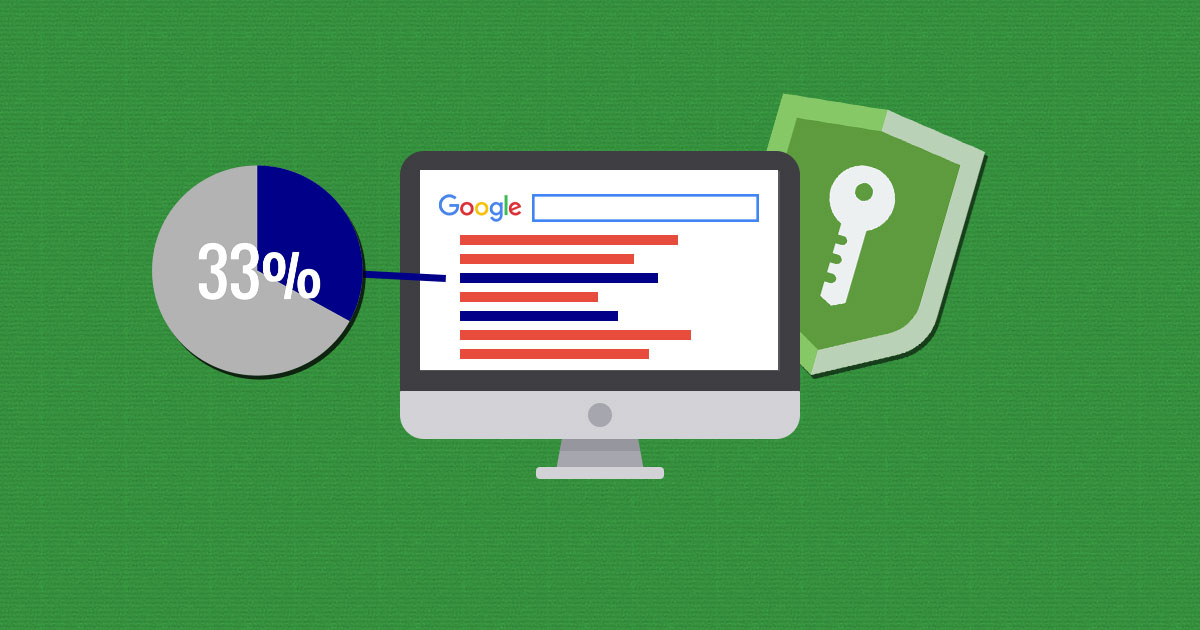

If you were to look at the results on the first page of Google.com for various search queries, you would notice that about one third of websites are already on a secure HTTPS connection. That’s exactly what the online marketing experts at MOZ.com did, analysing results for 10,000 keywords or search queries.
When did SSL certificates become so popular?
It is the case with virtually every product that the more and more successfully it is promoted, the more popular it becomes. SSL certificates are no different. Although the first HTTPS websites started appearing several years ago, the number of HTTPS websites started to increase rapidly from August 2014 onwards. At that time, the web giant Google announced on its official blog that it would start to consider HTTPS as one of the signals for ranking search results in its search engine.
You can imagine how high profile this news was and how quickly it spread across the web. Everyone would like to rank higher with their website, and if all it takes is an SSL certificate, the investment certainly makes sense.
Installing an SSL certificate is first and foremost about the security of data transmission and the credibility of the website, and in the case of business and extended certificates, also about the credibility of the company. Improving Google search engine positions is only of secondary importance.
The number of SSL-certified websites continues to grow
In the graph below you can see how the number of websites with an SSL certificate installed has increased since Google’s announcement.
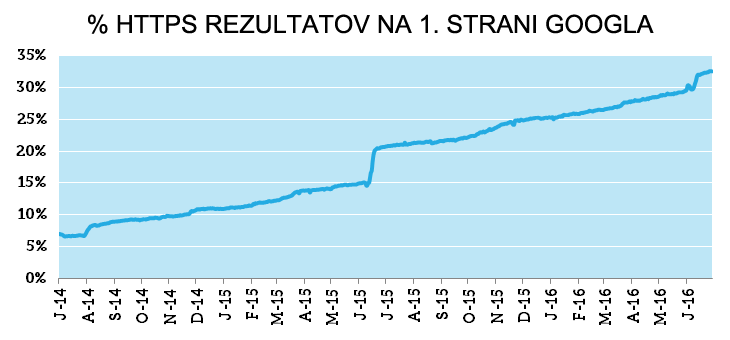
In fact, the graph also includes the month before the announcement, July 2014, when around 7% of websites were on an HTTPS connection. The number didn’t change much until the following month, but has grown linearly since then.
Today, around 33% of the top search results on Google are from websites with an HTTPS connection, and the graph shows a bigger jump in June 2015. Could you perhaps figure out for yourself what’s causing it? The answer is given at the end of this article, but until then, you might want to give it some thought.
Why is the data important?
Imagine if the trend of websites moving to HTTPS connections continued. In this case, 100% of sites would be on a secure connection in about five years. Logically, HTTPS as a factor in the search result ranking algorithm would become completely obsolete, as all websites would be given “better” positions.
For the time being, Google needs to be careful that the impact of an installed SSL certificate is not too great, as this could cause a lot of damage to quality websites whose owners have not yet made the switch to an HTTPS connection. In any case, the weight of the algorithm factor must be carefully determined and must also change over time.
Dr Peter J. Meyers, of MOZ, estimates that an algorithm update with a greater emphasis on HTTPS connections is on the way in the near future. This means that websites that have SSL certificates installed will receive a greater incentive or upward push than they currently do.
If you have not yet installed an SSL certificate on your website, now is definitely the time. At NEOSERV, we offer SSL certificates from the world’s largest issuer, Sectigo (formerly known as Comodo CA), at affordable prices. You can opt for a domain, business or extended certificate, and we’ll be happy to help you make the optimal choice for your site.
Let me add a note about the bump in the middle of the graph. In June 2015, Wikipedia decided to switch to HTTPS, which is more than obviously ranking very well in Google search.
COMMENT THE POST
Your comment has been successfully submitted
The comment will be visible on the page when our moderators approve it.