


- Your cart is currently empty.
Why Slower Online Stores Sell Less?

If you surf the web a lot, you’ve probably come across a slow website many times. Let us guess what you did in this case. You left the site before it had finished loading, or maybe you made a click or two and then got tired of waiting and looked elsewhere for information. The fact is that web users don’t like slow sites because, at today’s pace of life, they want information to be available as quickly as possible.
In the case of personal websites, where individuals do not benefit financially, the problem of slow sites is not so great, but the story is completely different for corporate websites, especially for online shops. In the case of the latter, it is extremely important that the visitor’s website is loaded as quickly as possible, otherwise there is a high probability that the visitor will leave the site and go to a competitor’s site. If you sell online, you certainly don’t want that to happen.
Why is a slow website a bad investment?
1. Visitors will leave the website quickly
We mentioned the first reason in the introduction. If a web page takes a long time to load, a certain proportion of visitors will leave before the page is fully displayed. Several studies have been done on how page load time affects the early departure of visitors.
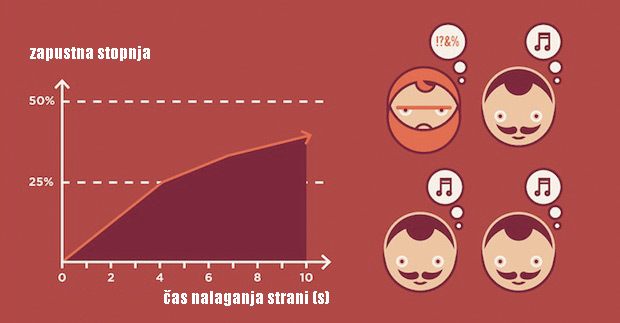
The results showed that around 25% of visitors leave at 4s and almost 40% leave at 10s. Interestingly, smartphone and tablet users are willing to wait a little longer, but again the trend is rapidly declining with the advent of more powerful devices.
2. A slow website does not inspire confidence
A website that loads slowly is less trustworthy in the eyes of the visitor. The visitor consciously or subconsciously perceives the website as of lower quality, which in turn influences his/her reactions or actions. In the case of an online shop, this means an increased chance of losing a potential customer and, of course, lower revenue.
In addition, the likelihood that a visitor who has visited an online shop will go to a physical shop of the same provider to buy the product is also reduced. Tellingly enough, a study by Amazon, a major online retailer, found that for every additional 100 ms of page load time, their sales fell by 1%.
3. Your website will rank lower in Google search
The third reason why website speed is so important is no less important than the previous two. The reason is that page load time is one of the most important factors in Google’s complex search engine algorithm. So what does this mean in practice?
If your website is displayed quickly to the visitor, Google will reward it with higher search engine rankings, which will undoubtedly have a positive impact on traffic and sales. It may be interesting to note here that Google is also continuously working to improve the speed at which it displays search results, with a 2012 study showing that a 400ms faster response time translates into around 8 million fewer searches per day.
How to speed up your website?
As you can see, the impact of website speed on sales volumes is of paramount importance. So it’s certainly not surprising if you’re wondering how to get your website to the visitor in less time.
We recommend that you follow the tips below to speed up your website, attract more visitors and improve conversions.
- Your website should be hosted on a reliable and responsive server. At NEOSERV, we can boast modern DELL server equipment(details) that ensure short response times.
- If the website is targeted at a Slovenian audience, the server should also be located in Slovenia. The same goes for abroad – rent a server in the country you are targeting.
- Make sure that all images on the page are properly optimised and as such take up as little space as possible. Learn about the different image formats and use the appropriate format (e.g. WEBP).
- Keep the HTML code of the web page as optimised as possible or as short as possible. Minimise CSS and JS files, which should be stored as external files, i.e. outside the HTML.
- Use a“caching” system to cache files.
- Use Google’s PageSpeed Insights tool for additional suggestions.

If you’d like to improve the speed of your website, but don’t think you’re up to the task due to a lack of technical knowledge or time, you can always contact us. Email us at info@neoserv.com or fill in the contact form. We will also be happy to take your call on +386 59 335 000.
COMMENT THE POST
Your comment has been successfully submitted
The comment will be visible on the page when our moderators approve it.