


- Your cart is currently empty.
Why Do Websites on HTTPS Load Faster

Installing an SSL certificate on a website has many advantages. Not only is all data transferred between visitors and the website over a secure HTTPS connection, but the website also loads much faster for visitors. This is because websites with an SSL certificate installed can run on the faster HTTP/2 protocol, whereas unsecured websites are “powered” by the slower HTTP/1.1 protocol.
The HTTP/2 protocol is based on the SPDY protocol, which was developed by a Google team in a research project. Unlike its predecessor, this protocol allowed multiple simultaneous requests between server and client on a single TCP connection, prioritisation of requests, faster encryption and improved compression. HTTP/2 has taken all of these advantages and further improved them.
| HTTP/1.1 | SPDY | HTTP/2 |
|---|---|---|
| SSL is optional but recommended. | SSL mandatory. | SSL optional but recommended. * |
| Slow encryption. | Fast encryption. | Even faster encryption. |
| One request between server and client per TCP connection. | Multiple requests between server and client on a TCP connection. | Multiple requests between server and client on a TCP connection. |
| No header compression. | Header compression. | Advanced header compression. |
| No prioritisation of requests. | Request prioritisation. | Improved prioritisation of requests. |
* Although HTTP/2 itself does not require the use of encryption, all the most popular web browsers (Chrome, Firefox, Safari, Opera, IE, Edge) only support the protocol via SSL/TLS. This means that encryption, and therefore the installation of an SSL certificate, is mandatory.
Comparison of HTTP/1.1 and HTTP/2 speeds
When we start researching on the web about how the speeds of the two protocols compare, sooner or later we come across the website https://www.httpvshttps.com/. Here you can see how much faster web page elements load on a secure HTTPS connection. The test compares the loading speed of 360 unique images– which are not cached – on HTTP (using HTTP/1.1) and HTTPS (using HTTP/2) connections.

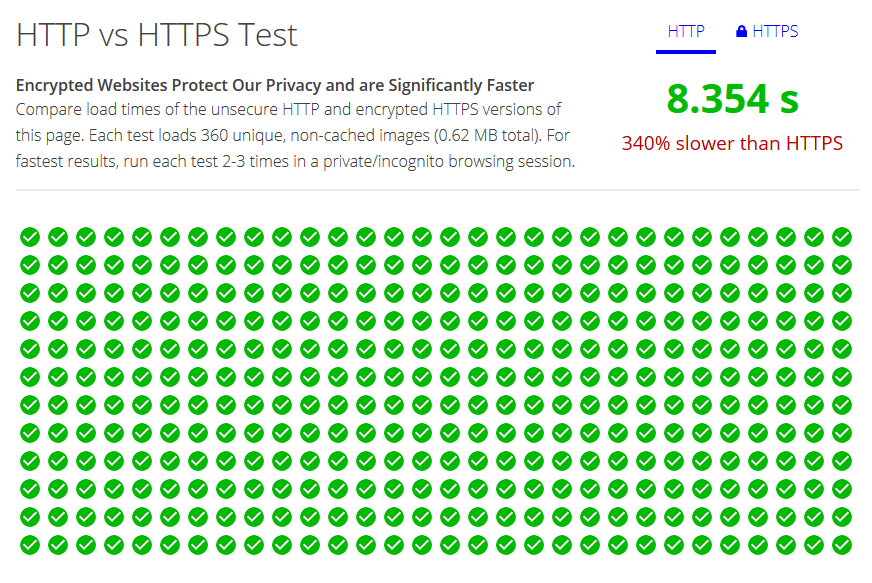
The difference in speed is more than obvious! There will certainly be some who will object to the results of the test and will think that the secured and unsecured connection should be compared on the same version of the protocol. But this simply does not make sense, as it is not even feasible on the vast majority of modern browsers. In fact, modern browsers only allow HTTP/2 over a secured HTTPS connection. The latter is nicely represented by a graphic available at Caniuse.com.

Note the small number 2 on the left-hand side of almost every window. Each box represents a browser version, and the number 2 indicates that HTTP/2 is only supported over TLS (HTTPS). Definitely a great reason to install an SSL certificate!

At NEOSERV, we offer SSL certificates from the world’s largest and most recognised issuer, Sectigo (Comodo CA), at affordable prices. Choose from domain, business and extended certificates. If you host your website with us, we will also install the SSL certificate for free.
HTTP/2 – simultaneous requests over a single TCP connection
The biggest advantage of the HTTP/2 protocol is the so-called multiplexing, which allows simultaneous processing of data streams between server and client over a single TCP connection.
Flow prioritisation provides an additional improvement, as the mechanism allows the server to optimise the allocation of network resources based on the end-user’s requirements.
A comparison of request processing in HTTP/1.1 and HTTP/2 can be seen in the figure below.
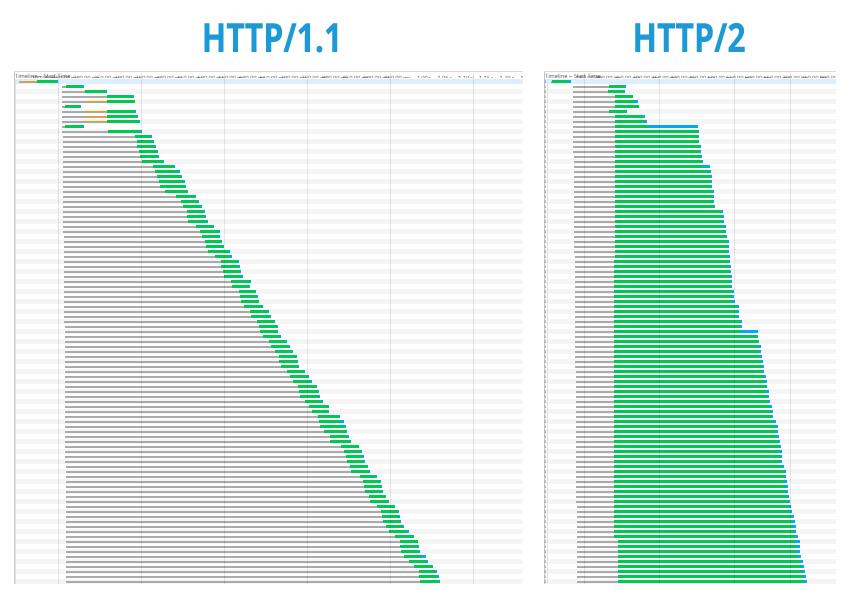
As you can see, the newer protocol processes multiple data streams at the same time. This is the reason why in the image loading speed test, almost all images are displayed at once on a secured HTTPS connection, while on an unsecured HTTP page they are displayed individually or in very small groups.
Choose a hosting provider that supports HTTP/2
Your web hosting provider should also make sure that the website on which the SSL certificate is installed works over the HTTP/2 high-speed protocol. Of course, at NEOSERV we upgraded all our servers some time ago to enable HTTP/2 over TLS.
Do you have a web hosting lease elsewhere and an SSL certificate installed on your site? Check whether your hosting provider supports the newer protocol. Do the HTTP/2 TEST – click on the link, enter the full web address of your website in the box and confirm your choice.
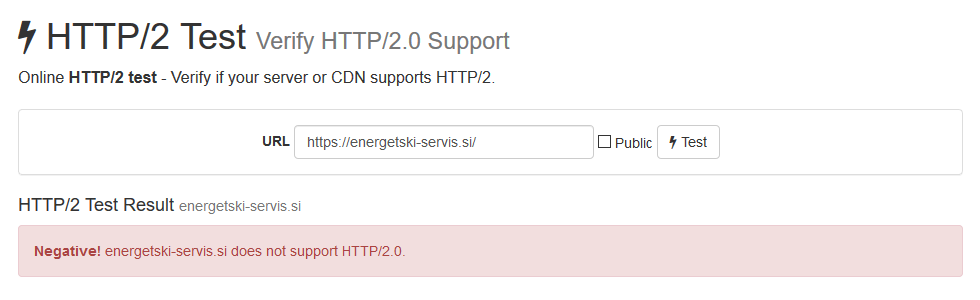
The figure above shows an example of a test result if the web hosting provider does not support HTTP/2. See also the example below, which shows a server with HTTP/2 support.
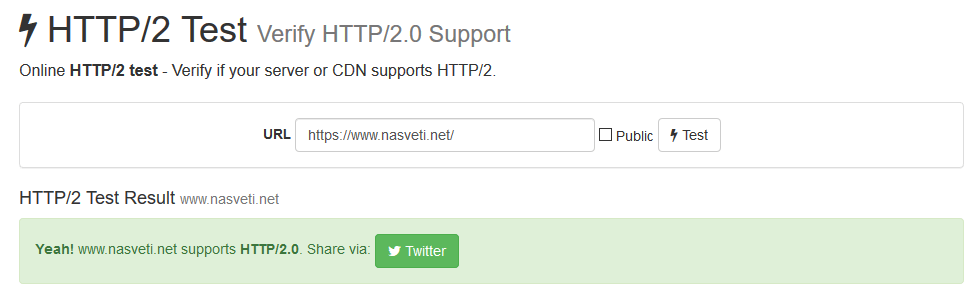
Have you done a test for your website? Did the result box turn green or red? If the server hosting your website does not support HTTP/2 protocol, we advise you to choose NEOSERV web hosting as soon as possible. You can be sure that your website will run faster with us!

And if you haven’t got an SSL certificate yet, you should definitely get one. Preferably before July 2018. Read why it’s so important to get a security certificate before then in this article.
Decide to install an SSL certificate and get your website up to speed today!
COMMENT THE POST
Your comment has been successfully submitted
The comment will be visible on the page when our moderators approve it.